LiveFive apps connected, every action verified
Spots the customer
about to leave
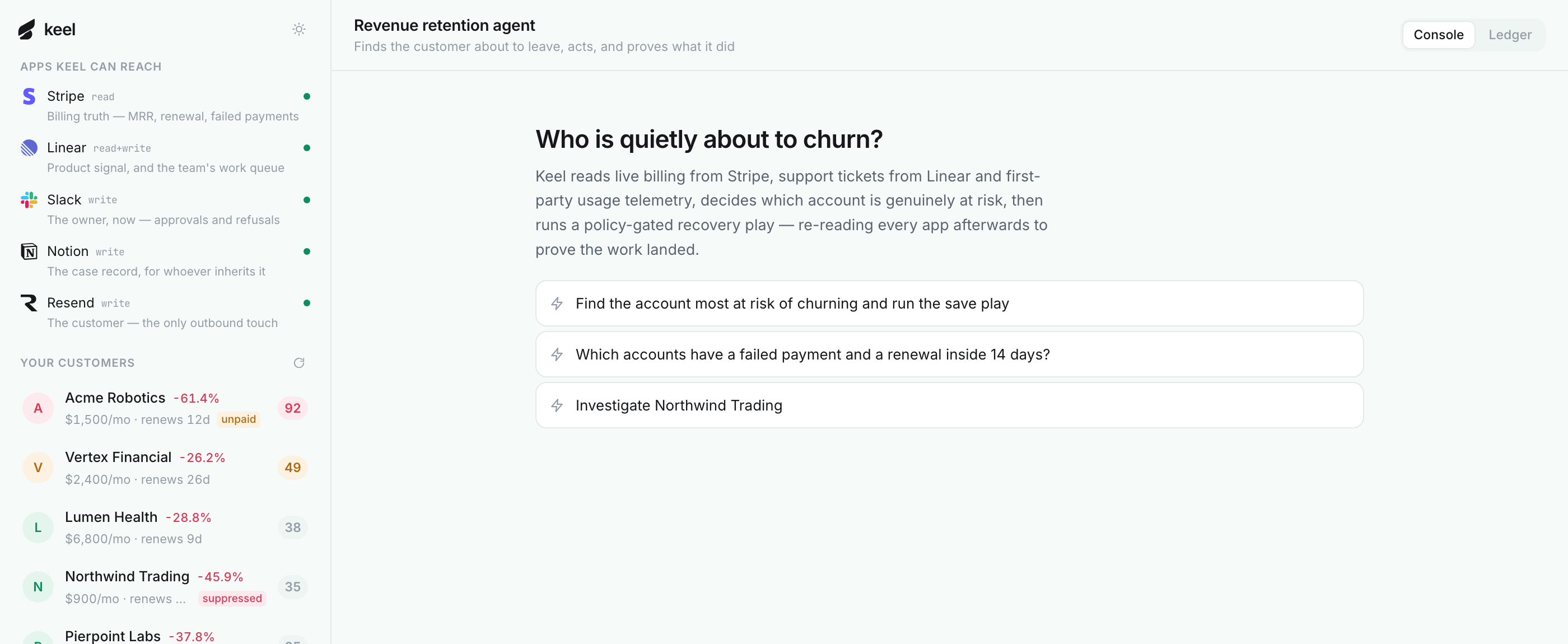
Every software company loses customers it could have saved. Quietly — someone stops logging in, a payment fails, a bug ticket sits open. Keel puts those signals together, acts on them, and proves what it did.
The model investigates.
The runtime decides.
Judgment is the part a language model is good at. Nothing irreversible should depend on it. So Keel splits the job in two — and only one half is allowed to improvise.
01
It goes and looks
Reads billing from Stripe, support tickets from Linear, and your own usage data. Nobody hands it a checklist — it decides which accounts to open and when it has seen enough.
02
It stops for you
Before anything a customer would see, a deterministic policy engine runs on the proposed plan. It can block an action outright, or hold the whole play for a human. The model does not get a vote.
03
It proves the work landed
After every write, Keel re-fetches the record from the app that should now hold it. An action is only done when the external system says so — and the whole trail is on the record.
An agent you could actually let near a customer
Finds the reason, not just the risk
A usage cliff is a symptom. Keel links it to the unresolved bug that caused it, and cites the ticket.
Refuses, and says why
Legal flags, open escalations, contact cooldowns and enterprise thresholds are plain code — auditable, and impossible to talk out of.
Never acts twice
Every write is keyed and looked up first. Replay a save play and nothing duplicates — no second email to the same customer.
Keeps the receipts
Everything it did, refused, or skipped, rebuilt from an append-only trail that outlives the session.
Five of the eighteen tests check that Keel does nothing
Anyone can demonstrate an agent doing something. The harder claim is that it declines when it should — on a legal hold, inside a contact cooldown, above an enterprise threshold, or when the work was already done. Those cases run on every commit.
Read the scorecard18/18
reliability cases pass
5
assert it does nothing
100%
of writes read back
0
duplicate actions on replay